

How The Krikya Exchange Differs From Standard Sportsbook Betting
In a standard sportsbook — what Krikya also offers through its SABA Sports-powered main sportsbook — you bet against the platform. You select an outcome, the platform offers you odds, and if your selection wins, the platform pays you. If it loses, the platform keeps your stake. The platform sets all the odds, takes a margin on every market, and is on the other side of every bet you place.
A betting exchange operates on a fundamentally different model. On the Krikya exchange, you are not betting against the platform — you are betting against other players. One player backs an outcome (bets it will happen). Another player lays that same outcome (bets it will not happen). The exchange matches these two positions, charges a small commission on net winnings, and takes no view on the result itself.
The practical consequences of this structure are significant for a Bangladeshi cricket bettor:
Odds Are Set By The Market, Not By Krikya
On the standard Krikya sportsbook, the odds on Bangladesh vs Sri Lanka are set by the platform's pricing team and include a built-in margin. On the exchange, odds are set by whoever posts the first offer — often a sharp bettor or a professional trading operation. If the market disagrees with those odds, someone posts a counter-offer at different prices. The exchange displays both sides and matches positions automatically. The result is that exchange odds are typically tighter (better for the bettor) than sportsbook odds on the same event, because there is no platform margin built into the price — only the commission on winning bets.
You Can Be The Bookmaker
The defining feature of exchange betting is the ability to lay outcomes — to take the bookmaker's side and bet that something will not happen. If you lay Bangladesh to win at odds of 2.00, you are promising to pay a bettor who backed Bangladesh at those odds if Bangladesh wins. You collect their stake if Bangladesh loses. This flexibility opens strategies that are impossible on a standard sportsbook.
The Commission Structure
Krikya's exchange charges commission on net winnings from each market. This is the exchange's revenue source instead of the bookmaker margin. Check the current commission rate in the exchange interface — it is typically displayed as a percentage of net winnings on each settled market. Commission is only charged on markets you win; losing bets carry no commission charge.
Why This Matters For Low-risk Cricket Strategies
Exchange betting allows positions to be built, adjusted, and closed mid-match in a way that sportsbook betting cannot replicate. A bettor who backs Bangladesh to win before a match, watches Bangladesh dominate the first 20 overs, and then lays Bangladesh at shorter odds to lock in a guaranteed profit regardless of the final result — is doing something that is simply not possible in the standard sportsbook format. This is what "trading a position" means in the exchange context, and it is the basis of the low-risk strategies.
Betswiz Exchange Vs Dream Exchange — Which One To Use And When
Krikya Bangladesh provides access to two separate exchange interfaces: BetSwiz Exchange and Dream Exchange (also referenced as Dream11 Exchange in some Krikya documentation). Both support back and lay betting. Both are accessible from within the same Krikya account using the same BDT balance.
Betswiz Exchange
BetSwiz is the primary exchange interface on Krikya and the one most Bangladeshi players interact with first. Its market coverage for cricket is broader, covering international fixtures, BPL, IPL, PSL, and other major T20 and Test series alongside the standard sportsbook cricket offerings. The interface displays odds in decimal format and shows both the back price (what you receive if your selection wins) and the lay price (the odds at which you can act as the bookmaker) side by side.
BetSwiz is suited to:
Bangladeshi players learning exchange mechanics for the first timeBPL and international cricket coverage, particularly Bangladesh national team fixturesLive in-play trading where odds move quickly during matchesOver/session betting on running totals
Dream Exchange
Dream Exchange is the secondary interface and offers a different selection of markets, sometimes with deeper liquidity on certain IPL fixtures. Players who primarily bet on IPL matches may find Dream Exchange more responsive during peak IPL match traffic, when high betting volumes on popular franchises like Kolkata Knight Riders and Mumbai Indians create tighter bid-offer spreads.
Dream Exchange is suited to:
IPL-focused bettorsPlayers who want to compare prices between both exchanges on the same match before committing
Which To Open First
For a player new to krikya exchange betting, start with BetSwiz for BPL and Bangladesh international fixtures. It has the most Bengali-language market commentary, loads efficiently on 3G connections common outside Dhaka, and is the interface Krikya’s support team will reference if you have a question about a live bet.
For IPL, open both during the first few matches of the season and compare the prices on the same market (Bangladesh national team vs the IPL favourite, for example). Use whichever shows a better back price if you are backing, or a lower lay price if you are laying. Over the course of a season, the difference may be small on any individual bet but compounds across many.
Back Betting Explained: What It Means And How Liability Works In Bdt

A back bet is the familiar side of exchange betting. You pick an outcome and stake money on it happening. If it happens, you win. If it does not, you lose your stake. This is mechanically identical to a standard sportsbook bet, with the difference that the odds come from the exchange market rather than from Krikya's pricing team.
How Back Bets Pay Out
Exchange odds are displayed in decimal format. A back bet at decimal odds of 2.50 on Bangladesh to win means:
Stake: 1,000 BDT
If Bangladesh wins: you receive 2,500 BDT total (1,500 BDT profit + 1,000 BDT stake returned)
If Bangladesh loses: you lose 1,000 BDT
This is your maximum liability as a backer — you can only lose what you staked. The odds determine your upside; your stake determines your downside.
The Back Bet In The Krikya Exchange Interface
When you open a match on the Krikya BetSwiz or Dream Exchange, each outcome displays two sets of odds side by side: the blue column (back odds — bet on this to happen) and the pink/red column (lay odds — bet on this not to happen). As a backer, you click the blue side.
Clicking the blue odds opens a bet slip that asks for your stake in BDT. The interface shows your potential profit at those odds. The minimum stake per exchange bet on Krikya is BDT 50. Confirm the bet and it is matched against a layer on the other side of the market — instantly if enough liquidity exists, or queued if the market is thin.
Unmatched Bets
If you request a back bet at a price where no layer is currently available, your bet enters the queue as an unmatched order. It will be matched when another player accepts the other side. During low-liquidity periods — very early pre-match on minor fixtures, or very early in a BPL group stage game — unmatched bets can sit in the queue for minutes without executing. For time-sensitive live bets, check that your bet is matched before the next ball is delivered; an unmatched bet does not place.
Lay Betting Explained: The Risk That Most Guides Understate

A lay bet is the bookmaker’s position. When you lay an outcome, you are betting it will not happen. If it does not happen, you collect the backer’s stake. If it does happen, you pay out at the agreed odds.
The formula that every player must understand before placing any lay bet:
Liability = Stake × (Lay Odds − 1)
Example: Lay Bangladesh to win at odds of 3.00 for a BDT 1,000 stake.
Your potential win: BDT 1,000 (the backer’s stake, if Bangladesh loses)
Your liability: 1,000 × (3.00 − 1) = 1,000 × 2 = BDT 2,000
If Bangladesh wins, you pay BDT 2,000. Your maximum risk is not the BDT 1,000 shown as the “stake” — it is BDT 2,000.
This is the fundamental difference between back and lay risk profiles, and it is where most first-time exchange bettors make their first significant error. A lay bet at high odds creates a large liability relative to the potential win. Lay Bangladesh at odds of 5.00 for BDT 1,000, and your liability is BDT 4,000 — four times the potential win.
The Krikya Exchange Handles Liability Automatically
The Krikya BetSwiz and Dream Exchange interfaces calculate your liability before you confirm the bet. The bet slip shows the stake you enter and, separately, the liability that will be reserved from your balance. If your BDT balance is insufficient to cover the liability, the bet cannot be placed. This is the correct safeguard — never attempt to circumvent it by reducing your balance through other means before placing a lay bet.
Where Lay Bets Make Sense At Low Risk
Lay bets carry proportionally lower liability when the lay odds are close to 1.00 — meaning the outcome is a strong favourite. If you lay a team at odds of 1.30, your liability on a BDT 1,000 stake is BDT 300. You are risking BDT 300 to win BDT 1,000 if the favourite fails. At these odds, the favourite is expected to win roughly 77% of the time (implied probability = 1 ÷ 1.30 = 76.9%), so this bet loses more often than it wins — but when it wins, the payout is proportionally larger.
Low-risk lay betting on the Krikya exchange is not about laying heavy underdogs at high odds. It is about laying strong favourites at low odds in specific match situations where the risk-to-reward is clearly defined. Sections 7 and 8 apply this to specific cricket scenarios.
Low-risk Strategy 1: Back The Favourite On First-innings Powerplay
What It Is
In T20 cricket, the powerplay (overs 1–6) heavily influences the match trajectory. Teams batting first typically aim to maximise powerplay runs against fielding restrictions. In BPL and IPL matches, teams with strong opening pairs — aggressive batters like Liton Das, Tamim Iqbal, or the IPL's top-order hitters — often post 50–70 runs in the first six overs on flat pitches.
The pre-match back on the batting favourite in a session runs market exploits this tendency with defined exposure.
The Setup
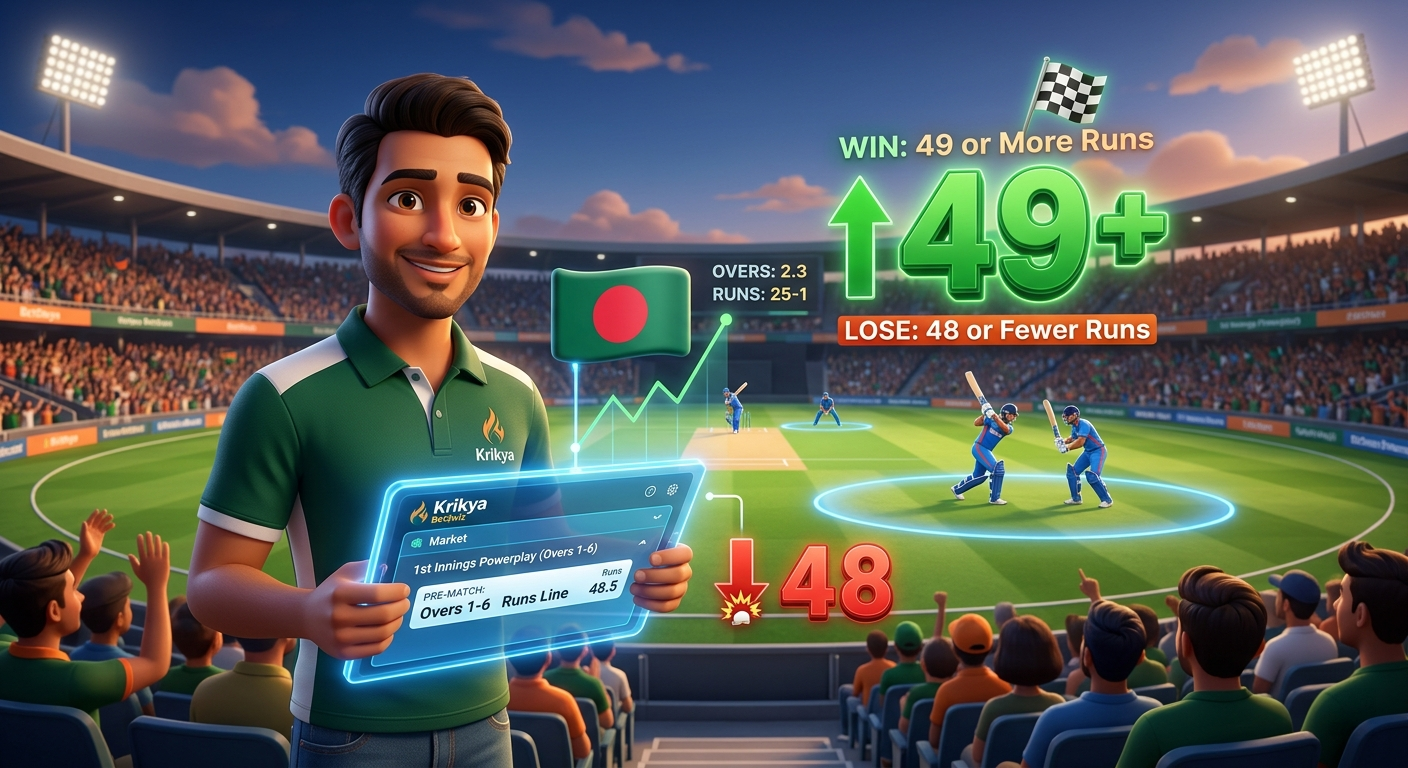
Pre-match: Open the session runs market for the first six overs on the Krikya BetSwiz Exchange. The market displays a run-line — for example, “48.5 runs in overs 1–6.” The back side says the team will exceed 48.5 runs; the lay side says they will score fewer.
Before the toss, if the batting-first team is a known powerplay aggressor (check their recent T20 powerplay scoring rates on Cricinfo, ESPNcricinfo, or CricketBD, all of which update within hours of a match), back “over” on the powerplay runs market at the available exchange odds.
How It Resolves
The market settles when the sixth over is bowled. If the team scores 49 or more, your back bet on “over” wins. If they score 48 or fewer, you lose your stake. The result is known within the first 20 minutes of the match.
Why It Is Lower Risk Than Match Winner Betting
A powerplay runs back bet resolves in 20 minutes against a specific, well-documented statistical tendency — T20 powerplay scoring rates are among the most consistent metrics in cricket analytics. You are not predicting the match result; you are predicting six overs of batting against a restricted field, which is significantly more bounded than predicting a full 40-over match outcome.
Your liability is exactly your stake — this is a back bet. You cannot lose more than you staked.
The Specific Risk
Powerplay runs collapse if an early wicket falls to a swinging delivery in the first two overs. Pace-friendly conditions in Mirpur (BPL) or seam-friendly pitches in some IPL venues (Delhi, Mumbai early season) reduce powerplay scores consistently. Check the pitch report and toss outcome before this bet — powerplay backing is a flat-pitch, batting-friendly-conditions play. If conditions favour pace bowling, do not place this bet.
Low-risk Strategy 2: Lay The Favourite After A Strong Start

What It Is
This is a live in-play strategy that uses the match odds market (match winner) on the Krikya BetSwiz Exchange. It is most applicable in BPL matches when one team dominates the first 10 overs and their match odds shorten from, say, 2.50 pre-match to 1.40 at the halfway point.
At 1.40, the favourite is priced at a 71% implied probability of winning. Lay odds of 1.40 means your liability on a BDT 1,000 stake is BDT 400 (1,000 × (1.40 − 1) = BDT 400). You collect BDT 1,000 if the team does not win; you pay BDT 400 if they do.
The Cricket Rationale
T20 cricket reverses dramatically. A team scoring 100 runs in 10 overs chasing 160 may look dominant — at 1.40 they are seen as near-certain winners. But a single wicket to a ball that takes an edge, followed by two more quick dismissals, can swing the match completely within three overs. The strategy backs this well-documented variability in T20 outcomes by laying the favourite at shortened odds when the liability is small.
The key condition: only lay the favourite when the lay odds are 1.50 or below. At 1.50, your liability per BDT 1,000 staked is BDT 500. Above 1.50, the potential liability grows rapidly while the underlying probability of the outcome is already high — meaning you lose this lay bet most of the time when entered above 1.50.
Example In BDT
BPL match: Comilla Victorians vs Chittagong Challengers.
Pre-match odds on Comilla: 2.00 (even favourite).
At over 12, Comilla needs 68 from 48 balls with 7 wickets in hand. Exchange price on Comilla: 1.35.
Lay Comilla to win at 1.35 for BDT 1,000 stake.
Liability reserved from balance: 1,000 × (1.35 − 1) = BDT 350.
If Comilla wins: you pay BDT 350.
If Comilla loses (does not win): you collect BDT 1,000.
You are risking BDT 350 to win BDT 1,000 — a 2.86:1 reward-to-risk ratio — on the chance that a team needing 68 from 48 with 7 wickets in hand still collapses. This happens regularly in T20 cricket. It is not guaranteed, but the liability at 1.35 is bounded and the BDT upside is significantly larger.
The Risk To Acknowledge
Most of the time, the team priced at 1.35 wins. A 1.35 implied probability is 74%. You lose this lay bet in approximately 74% of instances when the match dynamics truly reflect a 1.35 probability. The strategy depends on identifying situations where the exchange price overreacts to a strong start — where the true probability is lower than 74% because the remaining overs carry significant variance. Consistently identifying those moments requires cricket knowledge, not just price awareness.
If you lay at 1.35 every time a team looks dominant without assessing the specific match conditions, you will lose money over time despite the attractive liability structure. This strategy requires cricket judgment, not mechanical application.
Low-risk Strategy 3: The Over/under Session Runs Approach
What It Is
The session runs market — covering total runs in a specified over bracket — is the most bounded cricket market on the Krikya exchange in terms of variables. Instead of predicting who wins a match (which depends on batting depth, bowling quality, fielding, toss, conditions, and luck across 40 overs), you are predicting how many runs will be scored in a specified 5–10 over window.
The over/under session runs approach uses back bets on “under” in specific over brackets where scoring is structurally constrained.
The Cricket Rationale
Cricket has well-documented scoring rate patterns by over and by conditions:
— Overs 7–10 in T20 cricket (the “consolidation phase” between the powerplay and death overs) typically produce fewer runs per over than either the powerplay or the final five overs. Teams re-set after powerplay aggression and build partnerships before attacking in the death.
— Spin bowling in these overs on slow Bangladeshi pitches (Mirpur, Zahur Ahmed Chowdhury Stadium in Chittagong) produces significantly lower scoring rates than pace bowling on flat pitches.
— When a team has lost 2 wickets or more in the powerplay, the scoring rate in overs 7–10 typically slows further as new batters play themselves in.
The over/under strategy backs “under” on the runs line for overs 7–10 when:
a) The batting team has lost 2+ wickets in the powerplay
b) The pitch is spin-friendly (slow, low-bounce surface)
c) The bowling team has their best spin option bowling in this phase
Example In BDT
BPL match: Fortunate Barishal vs Sylhet Strikers.
Barishal has scored 45 runs in 6 overs but lost 2 wickets.
Sylhet’s lead spinner comes on for overs 7–10.
Pitch is a Mirpur turner, weather is dry.
Session runs line for overs 7–10: 35.5 runs.
Back “under” for BDT 500 at odds of 1.90.
If Barishal scores 35 or fewer in overs 7–10: return BDT 950 (BDT 450 profit).
If they score 36 or more: lose BDT 500.
The constraint here is concrete: you are not predicting match winner but a specific 24-ball window on a specific pitch type with specific bowling. The information advantage of a Bangladeshi cricket follower who knows the Mirpur pitch behaviour is directly applicable to this market in a way that it is not to a match-winner prediction that involves far more variables.
What This Strategy Requires
Real-time cricket information is essential. The session runs market reacts to each wicket and each boundary as it happens — you are betting on a compressed window that is already partly resolved by the time you access the exchange. A Bangladesh-based bettor watching the match live (BPL matches are widely broadcast in Bangladesh across BTV and Star Sports) has significantly more information than the exchange’s automated pricing algorithm in the 30–60 seconds after an unexpected wicket falls.
The session runs strategy does not work from delayed data or post-match analysis. It requires watching the match, seeing the pitch conditions, and knowing the bowling matchup before the target over bracket begins.
What Exchange Betting Cannot Guarantee — And What Separates It From Guessing

Exchange betting on the Krikya cricket exchange is not a guaranteed income mechanism. Every strategy in this guide carries the possibility of a loss, including the trading strategy that aims to lock guaranteed profit — that strategy only works if the market moves in your initial position’s favour before you trade out.
What separates exchange cricket betting from casino-style gambling is the source of the edge. In Aviator or Lucky Jet, the outcome is cryptographically random — no amount of cricket knowledge, form analysis, or pitch reading improves your odds above the house edge. Every bet has a built-in expected loss of 3% regardless of how carefully you play.
Exchange cricket betting is different in a specific way: the market does not set a price based on calculated probability. The price is set by other bettors, some of whom are acting on incomplete information, emotional reactions to on-field events, or simple inertia. A Bangladeshi bettor who watches every BPL match, knows the Mirpur pitch conditions from experience, follows Mushfiqur Rahim’s recent form closely, and understands how Bangladesh’s batting lineup responds under pressure in the 15th over — that bettor has genuine information advantages over the market pricing algorithm in specific moments. Exploiting those moments is what creates edge in exchange betting.
This is not the same as saying exchange betting is easy or reliable. Most bettors who open exchange accounts lose money, not because the model is flawed but because they apply it without the underlying cricket knowledge that the strategies require, or because they abandon the bankroll rules in Section 11 when variance runs against them.
The strategies in this guide — powerplay back bets, low-odds lay positions, session runs under betting, and trade-out positioning — are lower-risk than match winner speculation because they operate in bounded, well-defined market windows with specific conditions that must be met before placing a bet. They are not risk-free.
The conditions that must always be true before any exchange bet is placed on Krikya:
— You understand the liability calculation for lay bets before confirming any lay position
— Your stake does not exceed 10% of your session bankroll (back) or your total liability does not exceed 15% of your session bank (lay)
— Your stop-loss number is set before the first bet and will not be adjusted during the session
— You have watched the match and have a specific reason for the bet — not a general feeling about the outcome
A krikya bet placed with a specific reason and bounded risk is exchange betting. A bet placed on momentum and optimism is guessing with extra steps.

Leave a Reply